
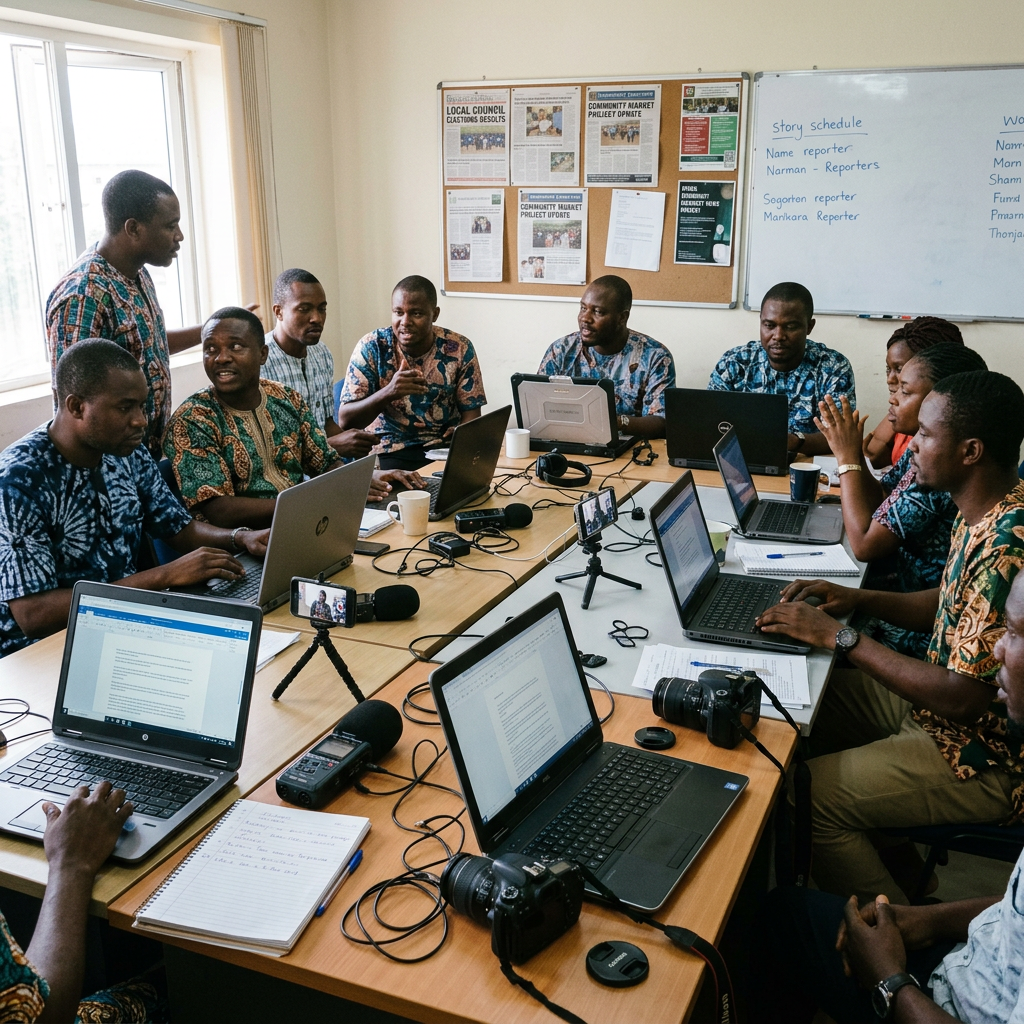
There is a myth, popular in the marbled offices of Ikoyi and Victoria Island, that Nigerian journalism is dying. I want to submit, respectfully, that Nigerian journalism is not dying. Lagos elite journalism is contracting. Abuja beltway journalism is calcifying. But in the alleys of Ejigbo, in the fabric stalls of Isolo, in the mechanic villages of Oshodi, journalism is doing something it has not done in a generation. It is coming home.
How Echonews Began
Echonews began in 2018 with three reporters, one laptop, and a printer I bought second-hand from a friend on Simpson Street in Lagos Island. Our first edition ran a story about a burst water main on Egbe Road that had been ignored for eleven months. Within a week, the Lagos Water Corporation dispatched a crew. That single story taught me more about the future of the press than a decade of editorials in the national papers.
The national newspapers had covered the state water policy. They had interviewed the Commissioner. They had published analytical think-pieces on infrastructure funding. What they had not done — what they structurally could not do — was walk down Egbe Road, count the days the water had been running into the gutter, photograph the woman whose provisions kiosk was slowly being undermined by the erosion, and put her name and her age in the paper.
That is the work Echonews was built to do.
Three Advantages of the Community Newsroom
The community newsroom has three advantages the national newsroom has structurally lost.
First, proximity. Our reporters live in the communities they cover. They buy tomatoes from the same women whose stories they write. They cannot afford, in the most literal sense, to lie. A national reporter can misquote a source in Ibadan and never see that source again. A community reporter will run into her at the pharmacy on Saturday. Accountability is not an editorial policy. It is a geography.
Second, granularity. National papers report on Lagos State. We report on Ile Iwe Street. That difference is not one of scale; it is one of kind. A citizen who cannot find her own street in the newspaper eventually stops reading the newspaper.
Third, trust. After eight years of consistent publication, Echonews has built the one asset that no amount of venture capital can purchase: the trust of a defined community. When we publish that a councillor has misappropriated funds, the community believes us — because we have been right too many times before, and because we have nowhere to run if we are wrong.
What This Means for the Future
The Nigerian press will not be saved by the national dailies rediscovering their old glory. It will be saved, if it is saved, by a thousand small newsrooms built in a thousand small communities, each accountable to a readership that can walk into the office and complain in person.
That is the model I am betting my remaining working years on. Echonews is only the beginning.
Leave a Reply