
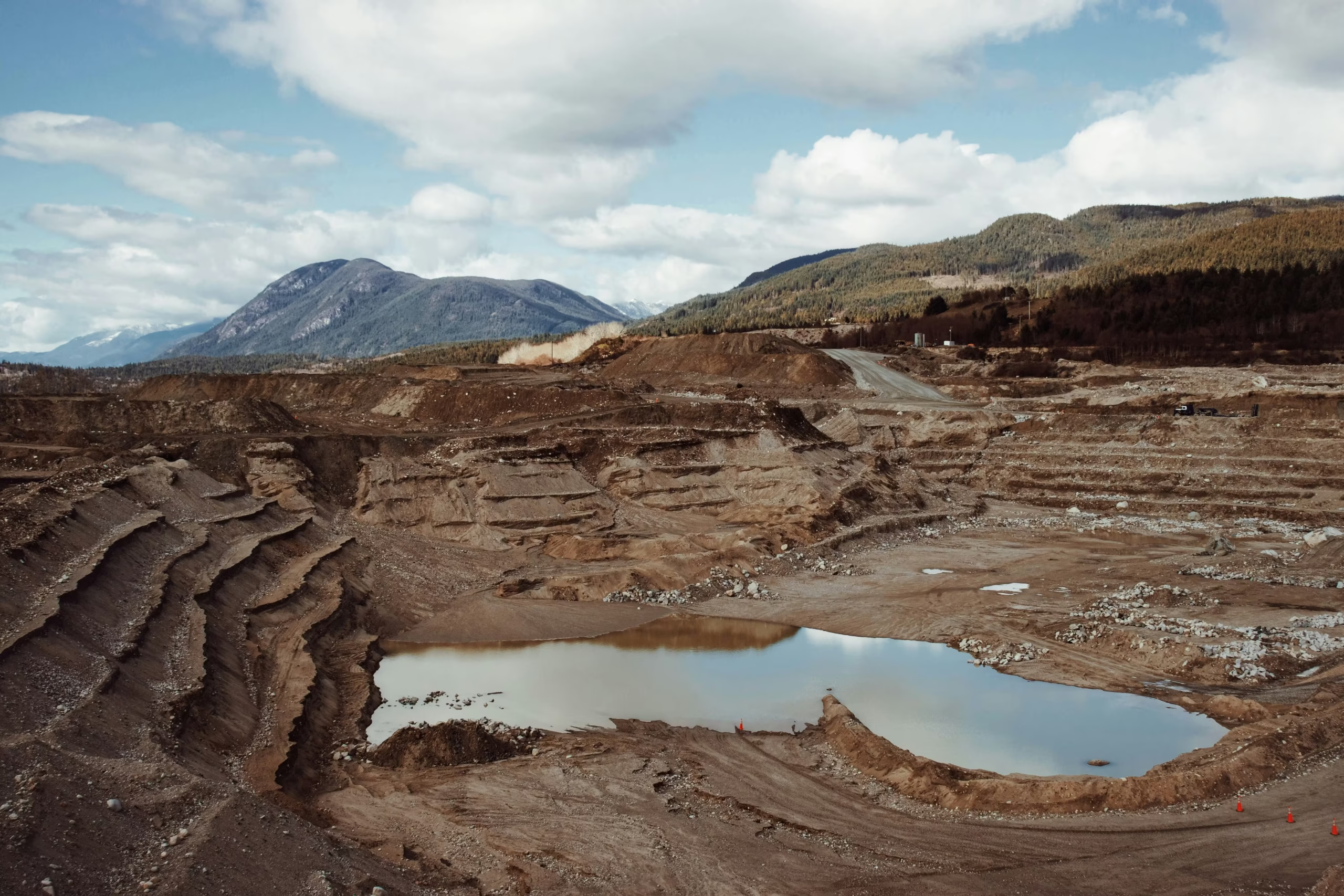
Nigeria’s economic history is a study in dependency. From groundnut pyramids to cocoa hills to crude oil terminals, we have built our fortunes on a single commodity at a time — and watched each empire collapse when the global price turned. The Honourable Minister of Solid Minerals Development, Dr. Dele Alake, is quietly assembling a policy architecture designed to make sure the fourth cycle is different.
I write this not as an outside observer but as someone privileged to serve as Special Adviser to the Minister. What follows is neither official policy nor personal advocacy. It is the reflection of a journalist who has, for the first time in his career, been given a chair at the table where the policy is drafted.
The Twenty-Five Month Ledger
In twenty-five months, three quiet revolutions have been engineered.
The mining title system has been substantially sanitized. For decades, mining licences were traded like inheritance certificates — often held by individuals with neither the capital nor the intention to mine. Under the Minister’s reform, dormant titles are being reclaimed and reallocated to operators who can demonstrate technical capacity and community engagement.
The Mines Marshals have been deployed. Illegal mining, long treated as an inconvenient nuisance, is now being treated as the security threat it always was. Sites have been shut down. Cartels have been dismantled. Artisanal miners, previously criminalized by default, are being formalized into cooperatives with legal cover and market access.
The host community framework has been rewritten. Communities that host mining operations are no longer spectators. They are, by policy design, shareholders. The percentage of the revenue that accrues to them is now protected, monitored, and — crucially — auditable by the community itself.
The Three Unanswered Questions
But three questions remain unanswered, and how we answer them will determine whether solid minerals becomes our salvation or our next cautionary tale.
Question one: Beneficiation. Nigeria still exports raw ore. Until we process lithium into battery-grade material within our borders, we will remain a colony of the value chain rather than a beneficiary of it. The policy framework acknowledges this. The infrastructure to execute it does not yet exist.
Question two: Revenue transparency. The Sovereign Wealth Fund model is well-designed on paper. Whether the political culture will allow it to function as designed is a separate matter. Every commodity boom in Nigerian history has been undone not by the boom but by what the boom did to our discipline.
Question three: The community compact. Host communities have been given a stake. Have we given them the technical capacity to manage that stake? A percentage of revenue that arrives in a community without governance capacity does not become development. It becomes the next conflict.
Why I Am Cautiously Hopeful
I have lived through four commodity cycles as a Nigerian journalist. I have seen each one end in the same disappointment. And yet I am cautiously hopeful about this one, for a single reason: the current architecture, for the first time in my working memory, has been designed with the previous failures explicitly in view.
Dr. Alake, whose newspaper career I have watched from my earliest days at Concord Press, is not a naïve reformer. He knows what killed the earlier booms. Whether he will be given the political time and the institutional protection to prevent the same causes from operating a fourth time is a question that will be answered not in his ministry but in the country’s political culture.
I remain, as always, at my post.
Leave a Reply